|
||
11. Dendritic melt pockets |
| Listing of Structures |
| Back...Next |
| Meteorite - Watson 001 IIE iron. |
|
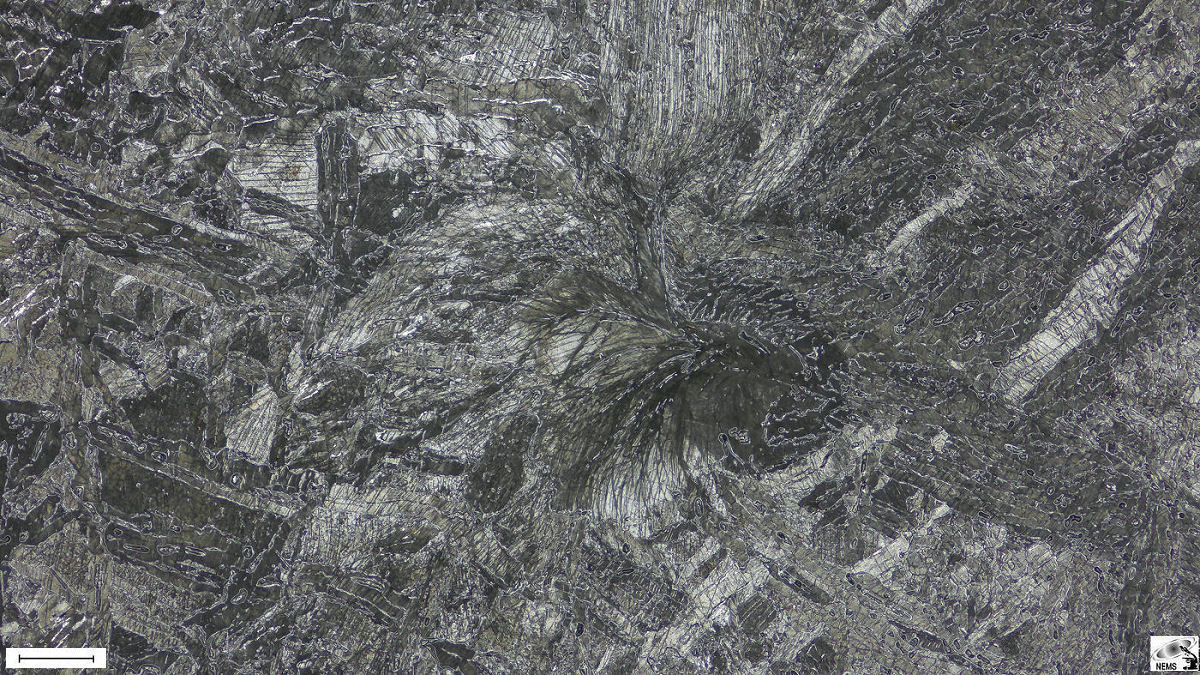
Figure 1.Scale bar 600 µm. "Whirlpools". Dendritic melt pocket, Watson 001, IIE iron. |
| Dendritic Melt Pockets
Meteorite: Watson 001 (IIE iron) Watson 001, a IIE iron meteorite recovered in South Australia (original mass ~93 kg), is notable for its silicate inclusions and complex shock-related microstructures. Analysis of a prominent silicate inclusion revealed a bulk composition consistent with H chondrites (after accounting for metal and troilite components). Oxygen isotopic data further align the inclusion with the IIE group, supporting a genetic link and derivation from a common parent body. Current petrogenetic models propose that the silicate inclusion represents H chondrite-like material that was engulfed by a subsurface Fe–Ni melt within the partially differentiated IIE parent body. The IIE group comprises 17 known members and exhibits varying degrees of silicate-metal mixing, with ongoing research refining the connection to H chondrite precursors through geochemical, isotopic, and chronological studies. A distinctive but less extensively documented feature of Watson 001 is the presence of dendritic melt pockets—localized regions of shock-induced partial melting that crystallized rapidly, producing intricate dendritic textures. These pockets, often described informally as “whirlpools” due to their swirling appearance, occur within the metallic host and provide evidence of high-strain-rate deformation and transient heating events. Interpretation as Secondary Structures In 1990, during the analysis of Watson 001, a prominent silicate inclusion was found to have a composition matching the H chondrites (minus the metal kamacite-troilite content). The oxygen isotope composition of this stony mass also matched the IIE iron meteorite class inferring the same parent body. A current model for this iron proposes that the silicate inclusion in Watson 001 was an H chondrite mass engulfed in a subsurface Fe/Ni melt within its parent body. Ongoing researchon IIE irons has shown a link between them and the H chondrite parent body. This association between IIE irons and the H chondrite parent body is being further refined. A scholarly document search will produce multiple papers on the subject. There is, however, less published research about the volume of dendritic melt pockets seen in Watson 001. The focus of this segment is to provide imaging stimulus and support for further study of this structural phenomenon. The dendritic morphology and associated distortion of kamacite lamellae (including Neumann bands and localized martensitic transformations) indicate these features formed as secondary structures during one or more impact events. Rapid crystallization from Fe–Ni–P–S melts during moderate to severe shock loading produced the fine dendritic networks, often surrounded by microcrystalline or martensitic metal. Similar melt pockets are reported in other IIE irons (e.g., Elga), where they reflect high-pressure, high-strain conditions up to several tens of GPa. These microstructures offer valuable insights into the collisional history of the IIE parent body, complementing models of impact-induced mixing between metallic cores and chondritic silicates. Further high-resolution studies (e.g., TEM, EBSD, and trace-element mapping) could quantify cooling rates within the pockets and constrain peak shock pressures and post-shock thermal annealing. This contribution provides high-quality imaging to stimulate additional research on dendritic melt pockets in Watson 001 and related IIE specimens, advancing understanding of shock metamorphism in iron meteorites. . |
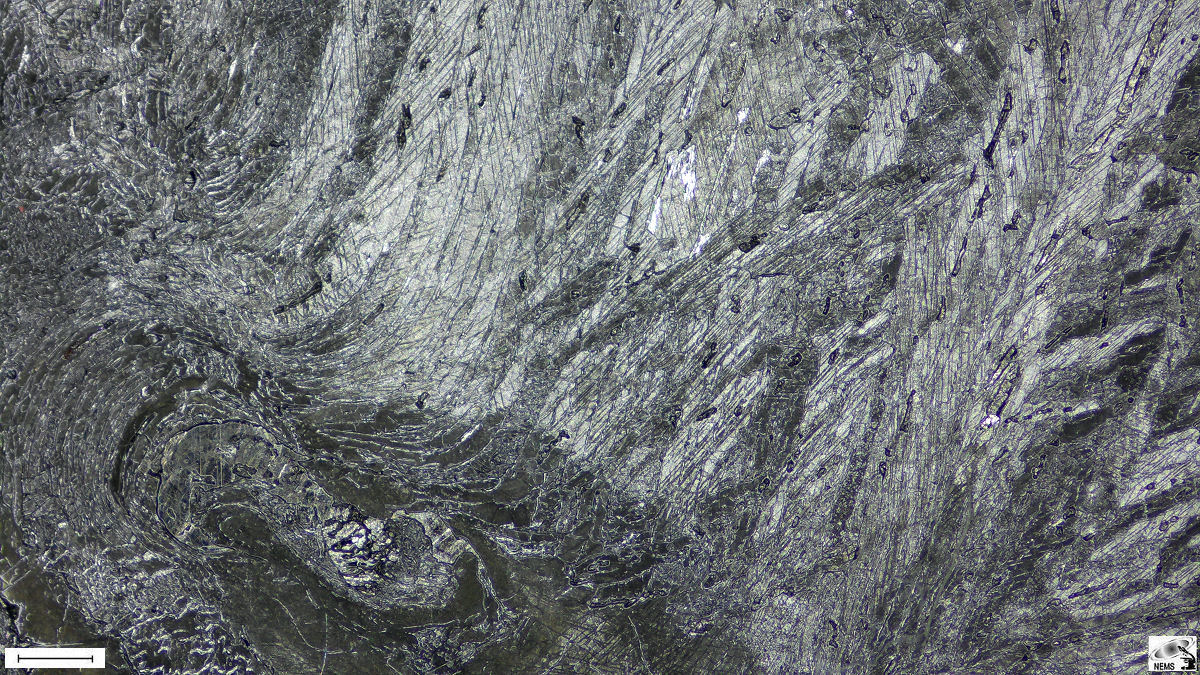
Figure 2. Scale bar 600 µm. |
| Dendritic melt pocket, Watson 001, IIE iron. |
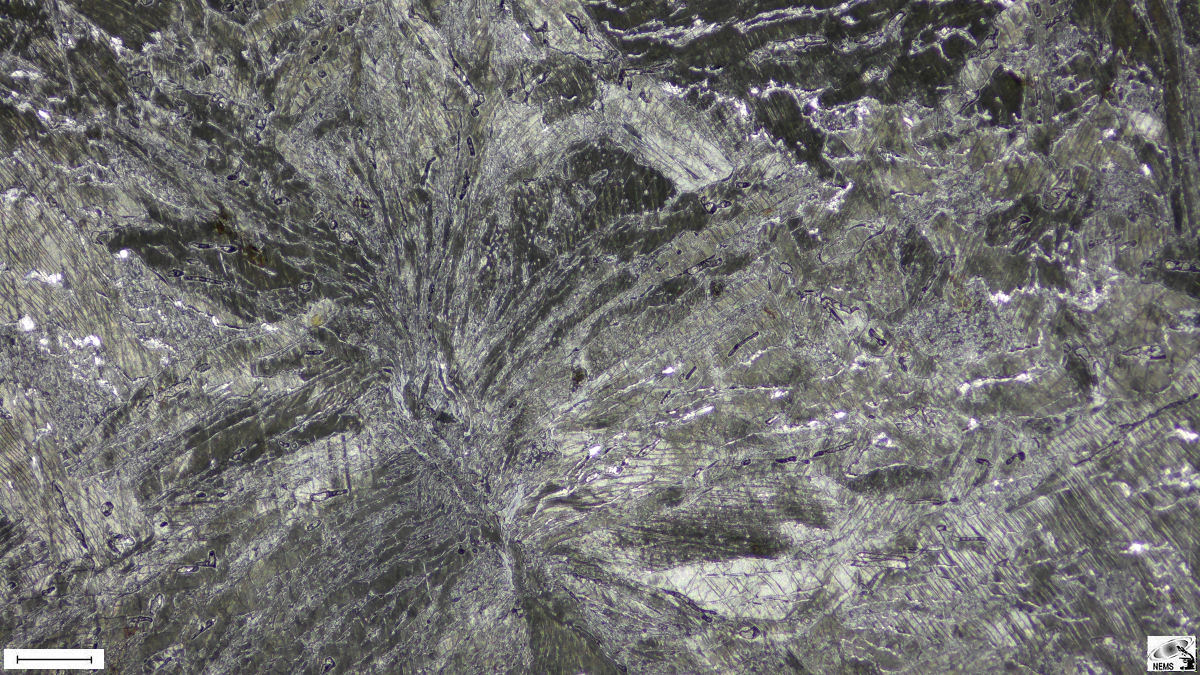
Figure 3. Scale bar 600 µm. |
| Dendritic melt pocket, Watson 001, IIE iron. |
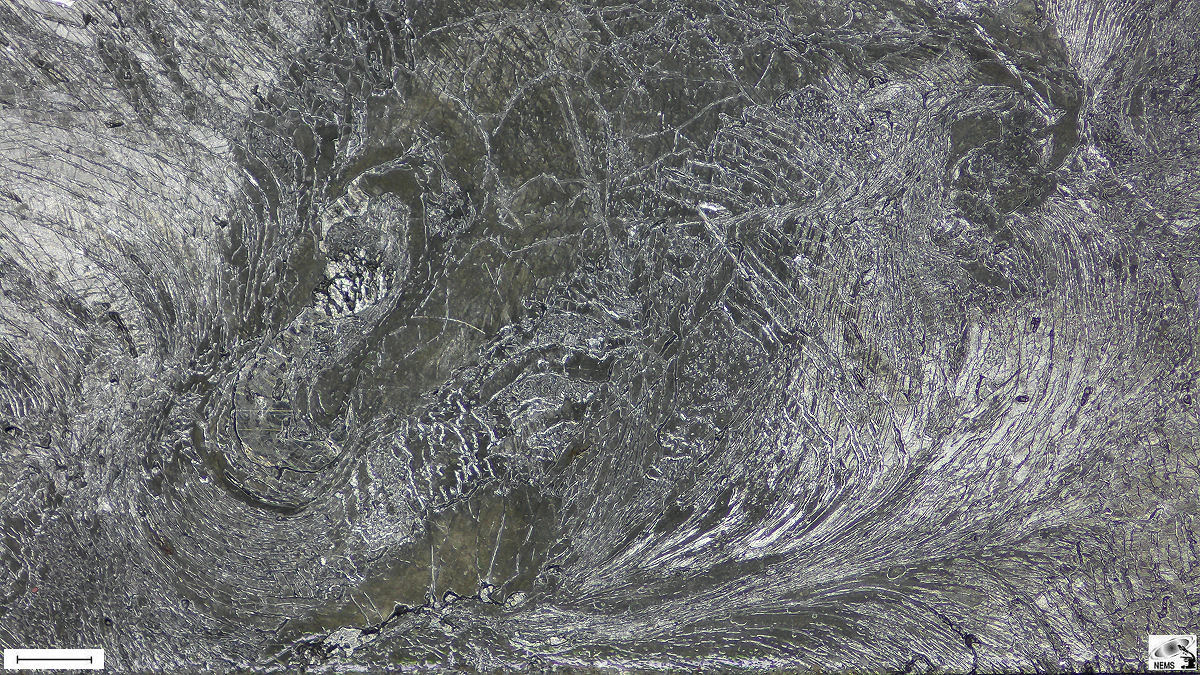
Figure 4. Scale bar 600 µm. |
| Dendritic melt pocket, Watson 001, IIE iron. |
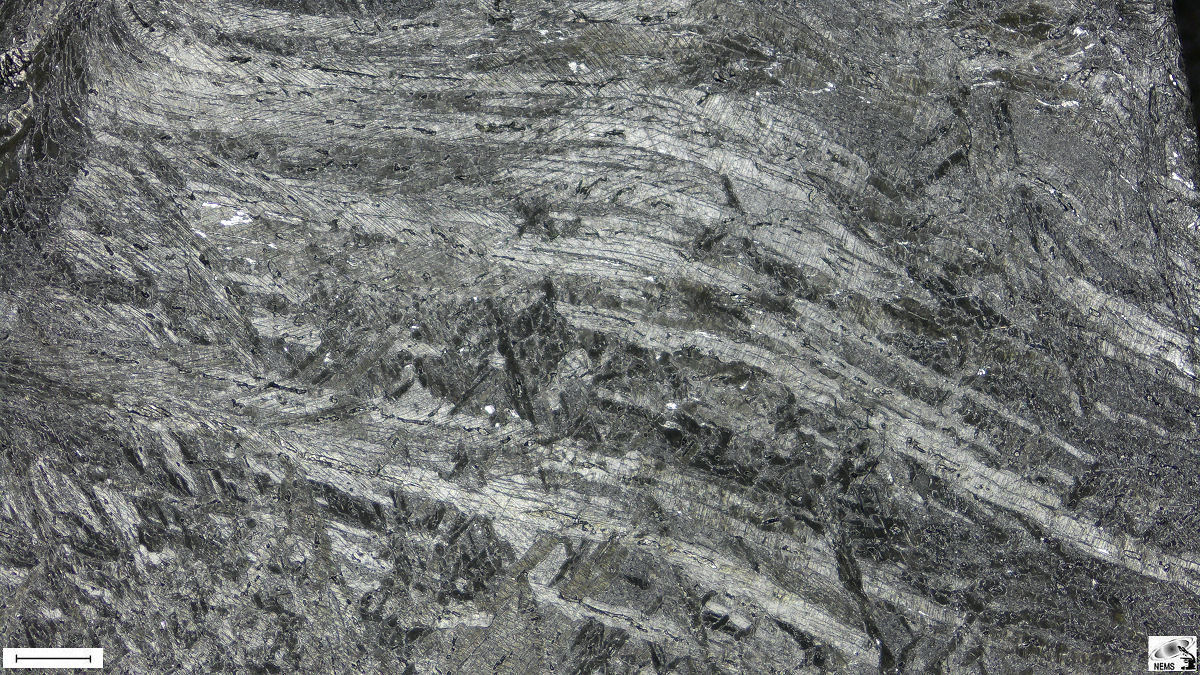
| Figure 5. Distorted kamacite lamellae adjacent to a melt pocket, indicative of shock deformation. Scale bar: 600 µm. |
| References • Olsen et al. (1994). Watson: A new link in the IIE iron chain. Meteoritics. • Meteoritical Bulletin Database • Studies on IIE–H chondrite relationships (e.g., Teplyakova et al., 2022; Rubin et al.). • Shock melt studies in IIE irons (e.g., on Elga and analogous features) |
| Listing of Structures |